
- Details
- Category: Our Strategy
- Hits: 2891
 We are in the midst of an environmental and social crisis. That might sound alarmist, but recent events have proven this to be an inconvenient truth.
As the world’s population continues to grow to reach 10 billion people by 2050, governments and businesses will need to find drastically different ways to make the food, products and resources we rely on to live.
We speak about the environmental and social challenges we face related to the climate crisis and inequality in our first posting of this publication, A sustainable post COVID-19 economic recovery: how the facts show us there is no other option.
Faced with this new reality, what can we do to create the systemic shift required to create a more sustainable and equitable society? And which factors can play a role in pushing companies in particular to take responsibility for their corporate footprints?
In other words, which drivers can encourage companies to consider their impact on both people and the planet as an intrinsic part of their operations?
The economic and social fallout from COVID-19 has accelerated scrutiny and debate about what stakeholder capitalism means in practice for company decisions and actions. A growing number of investors are viewing environmental and social risks as financial risks, and are pushing companies to consider them.
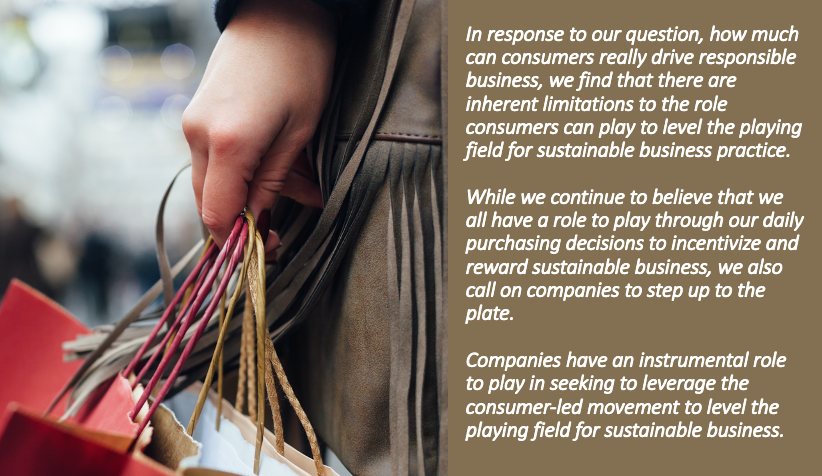
Read more: How much can consumers really drive responsible business?

- Details
- Category: Our Strategy
- Hits: 3726

The reasons for road traffic accidents are multiple and include rapid urbanisation, poor safety standards, lack of enforcement, people driving distracted or fatigued, influence of psychoactive drugs and alcohol, speeding, and failure to wear seat belts or helmets.
Malaysian data
Malaysia has the third highest fatality rate from road traffic accidents in Asia and Asean, behind Thailand and Vietnam.These fatality rates are similar to that of some African countries.By comparison, the fatality rates in developed countries are all in single digits.Transport accidents (5.4%) were the fourth most common cause of death in Malaysia in 2016, behind ischaemic heart disease (13.2%), pneumonia (12.5%) and cerebrovascular disease (6.9%).It was the third most common cause of death among men behind ischaemic heart disease and pneumonia, according to the Department of Statistics.There has been no change in the Malaysian fatality rates since 2007.The Global Status Report on Road Safety published by the World Health Organization (WHO) and the World Bank in December 2018 reported that Malaysia had 7,152 deaths in 2016, of which 87% were males and 13% females.In the same year, there were 27,613,120 registered vehicles, comprising 13,123,638 cars and four-wheeled light vehicles, 12,677,041 motorised two and three wheelers, 1,191,310 heavy trucks, 59,977 buses and 561,154 other vehicles.
Read more: We have the third highest death rate from road accidents
- Details
- Category: Our Strategy
- Hits: 3321
WITH a swipe of your finger, your order of pizza, fried chicken and burgers will be at your doorstep within minutes. There is no need to get into your car, drive to your favourite restaurant, find a parking spot, spend another 15 minutes getting your order through before finally getting your meal.The proliferation of mobile delivery applications has made it super simple to order a meal. The flip-side to this means that we have truly become a nation of couch potatoes.But it is a win-win situation for the restaurants as well as online delivery companies.The restaurant increases sales while the delivery company gets a percentage. It is even simpler with large fast-food chains who cut out the middleman by employing their own delivery service and dealing directly with the customer.The sheer number of food delivery apps available here is mind-boggling. I counted 11 of them, including popular ones like GrabFood, dahmakan, Delivereat and Foodpanda. And more and more companies are getting on the bandwagon. But have you stopped to think about how your meal gets delivered to you?
The demand for these services has seen a spike in the number of delivery riders on Malaysian roads. They are literally everywhere.You would not have failed to notice them, with their bright green or pink or prominent fast-food logo delivery bags fastened to their back seats.We appreciate the services rendered by these delivery riders, rain or shine, to get our food to our doorsteps. But the risks they take while doing their job is very worrying.A friend recently sent me a viral video of a delivery rider beating a red light and getting hit by an oncoming vehicle in Damansara Perdana. Actually, there are a few such viral videos out there. I have also had two close calls with these motorcyclists.The most recent happened last week in my neighbourhood. The rider in front of me, slowed down, sped up and then swerved to the right. As this happened about 10m in front of me, I had a first-hand look at the motorcycle rider, even as I tried to stop myself from colliding with him. The rider was checking his handphone with one hand while manoeuvring his bike with the other.
- Details
- Category: Our Strategy
- Hits: 4966

DUNIA kini memasuki Revolusi Digital atau Revolusi Industri 4.0. Penggunaan Internet (IoT), data besar (big data), pangkalan data awan (cloud computering), blockchain dan lain-lain pastinya akan mengubah corak kehidupan manusia.Sistem pendidikan negara sebagai contohnya, pelajar kini dapat mencari maklumat melalui internet untuk menyelesaikan tugasan sekolah mereka.Di kawasan bandar kini, kerja-kerja sekolah pelajar telah mula disimpan di sistem awan dan ia membolehkan alat menggantikan ibu bapa dan guru.Ia memungkinkan pendidikan lebih berkualiti ditawarkan apabila ibu bapa yang tidak memiliki taraf pendidikan tinggi bagi membimbing anak-anak mereka untuk belajar begitu juga di kawasan suar mendapatkan guru.Pada masa akan datang, tidak mustahil pembelajaran dan pengajaran pelajar boleh menjadi fungsi syarikat-syarikat penyedia perkhidmatan digital juga.Selain berada di sekolah, kanak-kanak boleh menikmati proses pembelajaran dan pengajaran yang lebih fleksibel di mana sahaja.
Sekarang sebahagian besar rakyat Malaysia adalah pengguna internet dan sebahagian besar melayarinya melalui telefon bimbit.Masyarakat kini lebih cenderung dihubungkan melalui media digital dalam menjalani urusan seharian seperti membeli-belah, membuat bayaran perkhidmatan termasuk juga mengulang kaji pelajaran.Sejumlah besar daripada golongan itu ialah orang muda yang suka dihubungkan dan berkomunikasi. Mereka juga suka kepada perubahan serta kelainan.Kebanyakan adalah generasi baharu yang mengalami peralihan dalam gaya hidup lama kepada tradisi baharu.
- You are here:
-
Home

-
News/Events
-
Who We Are
- Our Strategy