
 July 8, 2020 2:21 PM
KUALA LUMPUR: Socso says it has identified several syndicates involving middlemen that filed false permanent disability claims worth RM26 million.
Socso CEO Azman Aziz Mohammed said this could rise to RM68 million if the organisation continued to pay the sum claimed by these syndicates.
He said the fraudulent claims were identified between 2017 and 2019. A majority of them were reported to the police while the remaining are being investigated by the Malaysian Anti-Corruption Commission.
He reminded the public that Socso’s services were free of charge and there was no need for a middleman.
“Those who have been duped or used by these middlemen are urged to come forward to Socso,” he said at a press conference on MACC’s arrest of the scam’s mastermind.
Azman said the syndicates charged customers between RM15,000 and RM25,000, depending on the amount claimed by the contributor.
Read more: RM26 million in false claims lost to scammers, Socso says
 8 July 2020 10:29 am
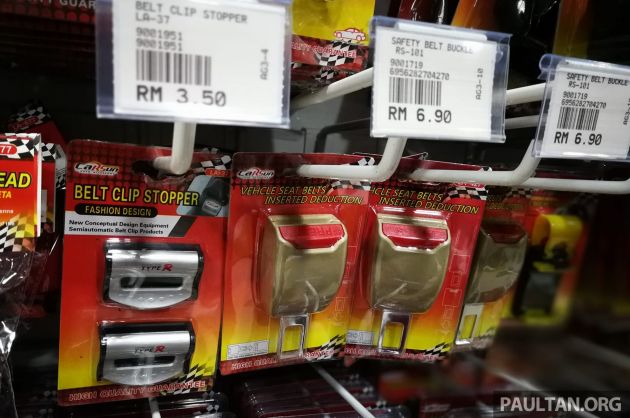
Lambakan penjualan aksesori kenderaan di pasaran tempatan yang mampu mengundang bahaya semakin menggusarkan pihak berwajib. Ini termasuklah penyambung tali pinggang keledar. Rata-rata pengguna yang membelinya adalah kerana tidak mahu memakai tali pinggang keledar apabila berada di dalam kenderaan dan tidak tahan dengan bunyi amaran daripada sistem keselamatan kenderaan yang mengesan pemandu atau penumpang tidak memakai tali pinggang keledar.
Aksesori sebegini memang sangat mudah untuk didapati di pasaran termasuk secara dalam talian, malahan dijual dengan harga yang begitu murah. Walau bagaimana pun, sedarkah anda, penggunaan aksesori sebegini boleh mengundang maut sekiranya anda terbabit dengan kemalangan jalan raya?
Disebabkan perkara ini, Institut Penyelidikan Keselamatan Jalan Raya Malaysia (MIROS) menggesa pihak kerajaan untuk mewujudkan satu peraturan yang melarang penjualan aksesori kenderaan yang berupaya mendatangkan risiko maut apabila berlaku kemalangan.
Menurut Ketua Pengarahnya, Dr Khairil Anwar Abu Kassim, sehingga kini penjualan aksesori kereta tertentu termasuk penyambung tali keledar adalah dibenarkan berikutan tiada undang-undang yang mengawal penjualannya di pasaran.
 Rabu, 8 Julai 2020 | 10:18am
KANGAR: Setiap kali tiba musim 'raja buah' pasti ada pengguna yang mengeluh, apabila berasa diri mereka tertipu selepas membeli durian pada harga tinggi sedangkan kualitinya tidak seberapa.
Lebih mengecewakan, apabila pulang ke rumah mendapati bahawa durian yang dibeli mengkal (tidak masak), busuk, tawar, isi berwarna putih dan sebagainya.
Presiden Persatuan Pengguna Melayu Malaysia (PPMM) Leftenan Kolonel (B) Che Hassan Che Johan, berkata sudah tiba masanya pihak kerajaan campur tangan memperkenalkan harga siling buah durian klon, mengikut gred.
"Sebagai contoh, harga buah durian jenis Musang King mempunyai gred A, B dan C, harga siling ditetapkan berdasarkan gred buah dan tindakan diambil kepada peniaga menjualnya lebih tinggi daripada harga yang telah ditetapkan," katanya kepada media, di sini, baru-baru ini.
Beliau mengulas laporan media sebelum ini, mengenai sikap segelintir peniaga durian yang menjual buah berkenaan, mengikut model kereta yang digunakan pembeli.
Read more: Harga durian perlu dikawal supaya pengguna tidak tertipu
 8 Julai 2020
SHAH ALAM - Jumlah pendapatan sebanyak RM2,150 sebulan boleh dijadikan kayu pengukur kepada kadar garis kemiskinan di bandar.
Timbalan Dekan (Pengajian Siswazah, Jaringan Industri dan Masyarakat) Fakulti Ekologi Manusia Universiti Putra Malaysia (UPM), Profesor Madya Dr Mohamad Fazli Sabri berkata, ia berpandukan kepada pendapatan RM4,360 yang dikategorikan sebagai golongan isi rumah berpendapatan rendah (B40).
“Katalah jika pendapatan isi rumah itu berjumlah RM4,360 bagi golongan isi rumah B40 dan dibahagikan kepada dua orang iaitu suami dan isteri, jumlah RM2,150 boleh dijadikan kayu pengukur dalam menentukan pendapatan miskin bandar.
“Dengan pendapatan isi rumah RM2,150 sebulan, pastinya tidak dapat menampung kehidupan di bandar,” katanya kepada Sinar Harian semalam.Mohamad Fazli bagaimanapun berkata, jumlah yang dinyatakan itu hanyalah pandangan beliau dan ia memerlukan kajian mendalam dan secara menyeluruh.
 Wednesday, 08 Jul 2020
BUTTERWORTH: Three-ply face masks cannot be recycled and those sending used face masks to recycling centres are putting people there at risk of infection.
Bagan Lalang Natural Resource Centre chairman Lim Chee Keong said volunteers at the centre received up to 50 non-woven face masks every day in the recycling bins when they should have been thrown away with other forms of domestic waste.
“Those who bring the used masks here have good intentions but are not aware of proper face masks disposal methods.
“At our segregation station, our volunteers have to suit up in protection gear to remove the masks from recyclable materials, ” said Lim.Three-ply or surgical masks are commonly made from mixtures of non-woven artificial fabrics and polypropylene thermoplastic and conventional recycling facilities cannot break them down for recycling.
Lim said the number of face masks found in their recycling bins were highest in April and May, when everyone was on high alert and used a lot of the masks daily.
Selasa, 7 Julai 2020 | 4:35pm
KAJANG: Institut Penyelidikan Keselamatan Jalan Raya Malaysia (MIROS) menggesa supaya diwujudkan satu peraturan yang melarang penjualan aksesori kenderaan yang berupaya mendatangkan risiko maut apabila berlaku kemalangan.
Ketua Pengarahnya, Dr Khairil Anwar Abu Kassim, berkata sehingga kini penjualan aksesori kereta tertentu termasuk penyambung tali keledar adalah dibenarkan berikutan tiada undang-undang yang mengawal penjualannya di pasaran.
"Peralatan ini tidak pernah 'tidak sah' dan ia boleh dijual di pasaran walaupun di kedai serbaneka, sedangkan jelas ia amat berbahaya jika digunakan pemandu kenderaan.
"Justeru, saya berasakan perlu diwujudkan satu undang-undang yang boleh mengawal atau menyekat penjualan aksesori kenderaan yang berbahaya kepada pengguna," katanya kepada BH, di sini.
Khairil berkata, pihaknya juga bercadang mengadakan pertemuan dengan pihak Kementerian Perdagangan Dalam Negeri dan Hal Ehwal Pengguna (KPDNHEP) membabitkan aspek penguatkuasaan.
July 8, 2020 7:30 AM
Investing in real estate has become a popular means of diversifying one’s investment portfolio. Largely illiquid, real estate is generally considered a defensive long-term investment and a hedge against inflation.
The unprecedented nature of the Covid-19 pandemic and its impact on the economy, together with existing market inefficiencies, has created an opportunity for arbitrage for the astute investor. The operative words here being “astute investor”, who is well-informed about the financial and market intricacies of investing in real estate.
This apparent opportunity is currently being peddled to the market at large in the guise of investor clubs and classes by investment “gurus”. In some cases it is being touted as a daring method to leverage oneself out of debt, and there has been a fair number of casualties.
Raine & Horne International + Zaki Partners senior partner and Fiabci president Michael Geh said a strategy is being advocated by some property investment gurus, advising prospective homebuyers to invest in more than one property to make fast money at this juncture.
“These property gurus guide potential buyers, especially millennials, to take on multiple financing, also known as loan compression. It is also associated with get-rich-quick schemes. However, this is not a new strategy as it has been practised for ages,” he told Property Advisor.
Read more: Why millennials must know that loan compression is a scam
July 7, 2020 11:27 PM
KUALA LUMPUR: The coming three to six months will be crucial for the successful implementation of the National Economic Recovery Plan (Penjana), which is expected to show results by the third or fourth quarter of 2020, the finance minister said.
Tengku Zafrul Aziz said Malaysia’s move to cut the overnight policy rate (OPR) today to a record low of 1.75% from 2% previously was driven by global economic conditions, which were still in the early stages of recovery from Covid-19.
He said that based on forecasts by various agencies such as the World Bank and International Monetary Fund, more than 150 of the 195 countries globally were expected to record economic contraction in 2020.
“The decision to reduce the OPR is aimed at accelerating the rate of recovery and further stimulate the country’s economy.
“The government believes that this move, combined with proactive measures deployed since March under the Prihatin and Prihatin SME+ economic stimulus packages and, more recently the National Economic Recovery Plan (Penjana), will be able to regenerate the economy by creating jobs, restoring consumer and investor confidence, as well as containing the likelihood of a sharp economic contraction,” he said in a statement.
 Tuesday, 07 Jul 2020 12:19 PM MYT
PUTRAJAYA, July 7 — The country could see a higher poverty rate as the government works to introduce a revised poverty line index (PLI), Minister in the Prime Minister’s Department Datuk Seri Mustapa Mohamed said today, following criticisms in a report published yesterday.
Mustapa said the new (PLI) will see a new methodology introduced, dubbed the 2019 methodology, which will include updated figures surrounding poverty as well as to better reflect the current social-economic situation in the country.
The previous methodology was formulated in 2005, with poverty currently benchmarked at RM980 at the national level and calculated based on the basic requirements for a household to live healthily and actively, according to the Department of Statistics.
The national poverty rate is only at 0.4 per cent, based on the 2005 methodology.
“If before this, the figures are at 0.4 per cent, then the percentage based on the new figures which we have dubbed the 2019 methodology, firstly the quantum of RM980 would definitely be higher, secondly it would be higher than 0.4 per cent,’’ he said to the press after the launch of Census 2020 by Prime Minister Tan Sri Muhyiddin Yassin here,
Mustapa added that the revision into the PLI had taken place during the Mid-Term Review of the Eleventh Malaysia Plan in 2018.
Mustapa explained that the Department of Statistics had already conducted the revision of the necessary figures and the results have already been tabled to the Cabinet.
Page 31 of 74
- You are here:
-
Home

- News/Events